
Owen Wilsons Military School Years Cheating Struggles and the Road to Hollywood
Owen Wilson’s movie persona can feel effortless. The drawl, the crooked grin, the half-mischievous calm, the sense that he just wandered into the scene and somehow made it funnier. But the road that shaped him was not as easy as his screen presence suggests.
Before Wedding Crashers, Zoolander, The Royal Tenenbaums, or the voice of Lightning McQueen, Wilson was a restless Dallas kid who got himself into serious trouble at school. His teenage years included academic pressure, a cheating scandal, a military school reset, and the kind of failure that can either shrink a person or sharpen their instincts.
That early chapter matters because Wilson did not become interesting by following a clean, polished path. He became interesting because he understood embarrassment, rule-breaking, second chances, and the strange comedy of being out of place.

A Dallas childhood with talent, trouble, and brothers nearby
Owen Cunningham Wilson was born in Dallas, Texas, on November 18, 1968. He grew up in a creative, sharp-witted household. His mother, Laura Wilson, became known as a photographer. His father, Robert Wilson, worked in advertising and public television. The Wilson home had culture, humor, and a sense that storytelling mattered.
Owen was not the only future actor in the family. His older brother Andrew Wilson and younger brother Luke Wilson also entered the movie world. That sibling energy seems important when looking at Owen’s later work. So much of his comedy depends on banter, timing, teasing, and the ability to seem both confident and slightly wounded at once. Those are skills often learned around a dinner table, in bedrooms shared with brothers, or during arguments that turn into jokes.
Dallas gave Wilson a particular kind of background. He was not raised inside the Hollywood system. He did not start as a child actor molded by auditions and agents. He came from a privileged but demanding educational world, one where private schools expected students to perform and behave.
Wilson attended St. Mark’s School of Texas, a prestigious boys’ school in Dallas. St. Mark’s has long been associated with academic rigor and high expectations. For a student who felt restless or boxed in, that environment could be both an opportunity and a pressure cooker.
Wilson has often been described as bright but not always compliant. That distinction follows him through much of his story. He was smart enough to see angles. He had a writer’s ear early on. But he also had trouble staying inside the lines.
The incident that changed his teenage years involved cheating. Accounts usually connect it to a geometry class. The details vary depending on the telling, but the basic story is consistent: Wilson was caught cheating at St. Mark’s and was expelled.
That moment could have become a neat moral lesson. A promising student breaks the rules, pays the price, and learns discipline. But real lives rarely move that cleanly. For Wilson, the fallout was messy and humiliating. It also sent him into an environment that would become one of the most revealing chapters of his youth.
He was sent to military school.
Military school placed him in a world built on order
After his expulsion from St. Mark’s, Wilson attended the New Mexico Military Institute in Roswell, New Mexico. For a teenager from Dallas who had just been caught cheating, it must have felt like more than a school transfer. It was a public correction.
Military school operates on a different rhythm from a regular academic setting. The day is structured. Students live with rules that reach into the smallest details. How to stand, when to wake up, how to dress, how to address authority, when to move, when to stay silent.
For someone like Wilson, that setting created friction.
The popular image of military school is simple: discipline turns a rebellious kid into a focused adult. Sometimes that happens. But Wilson’s story suggests something more complicated. Structure did not magically erase his personality. It gave him something to push against.
At New Mexico Military Institute, he was placed in a world where improvisation was not exactly encouraged. Yet improvisation would later become one of his defining artistic strengths. His loose, sideways comic style feels like the opposite of parade-ground discipline.
That contrast is part of what makes this period so fascinating.
Wilson was not a hardened delinquent. He was a teenager who had made a bad choice, then found himself in a place designed to correct behavior through routine and hierarchy. The experience likely taught him what it feels like to be judged by a single mistake. It also exposed him to characters, language, authority figures, and social rituals that could later feed a writer’s imagination.
A military school campus is full of roles. There are rule followers, rebels, quiet observers, loud enforcers, students trying to disappear, and students trying to turn the whole thing into a performance. Wilson, whether he knew it or not, was gathering human material.
The phrase Owen Wilsons Military School Years Cheating Struggles and the Road to Hollywood sounds almost like a movie pitch because the ingredients are so cinematic. A kid gets kicked out of an elite school, lands in a strict institution, stumbles again, and later turns awkwardness into art.
Still, the experience was not just colorful background. Wilson struggled academically and personally during this period. Some retellings of his youth compress the story into a blunt summary: he cheated, went to military school, and flunked out. The exact wording varies across profiles, but the larger point remains steady. His teenage years did not project future movie-star certainty.
They projected uncertainty.

Cheating, flunking out, and the hard education of failure
Cheating scandals carry a special sting because they are not only about grades. They are about trust. When Wilson was caught cheating, the consequence was not a quiet warning or a bad mark. He was expelled from one of Dallas’s most respected schools.
That kind of punishment can brand a teenager. It changes how adults look at you. It changes how peers talk about you. It can also change how you see yourself.
For Wilson, the scandal introduced a theme that later showed up in his work: the flawed person who remains likable. Many of his best characters are not model citizens. They bend rules, dodge responsibility, charm their way out of problems, and sometimes disappoint the people who care about them. Yet they are rarely cruel. They are usually trying to survive with humor.
That emotional territory did not come from nowhere.
The military school chapter seems to have placed Wilson face-to-face with limits. He could not simply charm his way through every situation. He could not assume a clever shortcut would work. He had to live with consequences.
Flunking out, or being remembered as someone who flunked out, adds another layer. Failure in school can feel final when it is happening. Adults often speak as if a transcript is destiny. For a teenager, poor grades or expulsion can seem like proof that the future has narrowed.
Wilson’s later life shows the opposite.
His early failure did not vanish, but it became part of the material. It gave him a relationship with humiliation. It taught him the comic value of being exposed. On screen, Wilson often plays men who are trying to preserve dignity while everyone can see the cracks.
Think of the wounded confidence in The Royal Tenenbaums, where he plays Eli Cash, a neighbor who wants badly to belong to a brilliant, damaged family. Think of the easy bravado in Wedding Crashers, where his character lives by charm before real feeling complicates the act. Think of Bottle Rocket, where the characters dream of criminal sophistication but remain almost childlike in their planning.
These roles work because Wilson understands that people can be ridiculous and sincere at the same time.
Cheating and academic failure also may have shaped his writing. A writer needs to notice contradiction. Wilson’s early life gave him plenty. He came from opportunity, but he stumbled. He entered strict institutions, but he had a loose spirit. He got punished for dishonesty, yet later built a career partly on emotional honesty.
That is not to excuse cheating. It was a mistake with real consequences. But culturally, people often talk about teenage failure in one of two ways. Either it gets treated as a permanent stain, or it gets turned into a cute origin story. Wilson’s case sits somewhere more honest.
He did something wrong. He paid for it. He struggled again. Then, over time, he found a place where his sensitivity, humor, and odd timing could become strengths.
That place was not a classroom. It was film.
The University of Texas changed the direction of his life
After military school, Wilson eventually landed at the University of Texas at Austin. This is where his story takes a decisive turn. At UT, he met Wes Anderson, a fellow student who would become one of his most important creative partners.
Their friendship changed both of their careers.
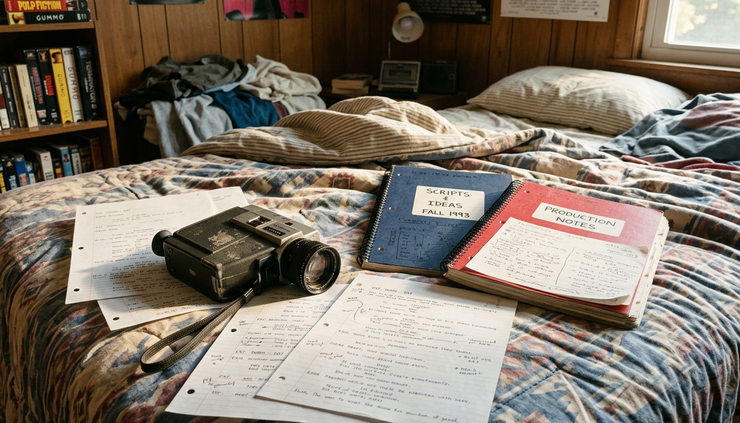
Anderson had a precise visual imagination. Wilson had a gift for voice, humor, and character. Together, they began developing what became Bottle Rocket, first as a short film and then as a feature released in 1996.
The story behind Bottle Rocket has become part of indie-film lore. It was not an obvious commercial launchpad. The movie follows would-be criminals whose ambitions far exceed their competence. It is funny, melancholy, and strangely tender. The characters want danger and importance, but they are also innocent, almost fragile.
That emotional mix feels closely tied to Wilson’s own history. A person who has known failure from the inside can write losers without mocking them. The characters in Bottle Rocket are foolish, but the movie cares about them.
Wilson co-wrote the film with Anderson and acted in it alongside Luke Wilson. The film did not become a blockbuster, but it attracted attention from filmmakers, critics, and industry figures who saw something distinct in its tone. It helped open the door to later Anderson films, including Rushmore and The Royal Tenenbaums.
With The Royal Tenenbaums, Wilson and Anderson received an Academy Award nomination for Best Original Screenplay. That moment alone says a lot about the long arc from school trouble to Hollywood recognition. The teenager expelled for cheating in geometry became an Oscar-nominated screenwriter.
The irony is hard to miss.
School had judged Wilson through discipline and grades. Film judged him by voice, feeling, timing, and originality. Once he found the right medium, what once looked like distraction began to look like perception.
His screenwriting partnership with Anderson revealed a specific talent. Wilson understood characters who were overconfident and underprepared. He understood boys and men who invented identities to cover insecurity. He understood the comedy of plans falling apart.
Those ideas would stay with him.
Hollywood rewarded the qualities school could not measure
Owen Wilson’s acting career grew during the late 1990s and early 2000s. He moved between independent films, studio comedies, action comedies, and voice work. That range became one of his quiet strengths.
He could play laid-back, but he was rarely blank. His best performances carry a subtle ache. He often seems amused by life while also slightly bruised by it.
That quality made him useful to very different directors. In Wes Anderson’s films, he fit into carefully arranged worlds full of loneliness and strange family pain. In mainstream comedies, he brought warmth to characters who might otherwise seem smug. In action comedies like Shanghai Noon, he used his loose timing against more traditional genre beats. In Zoolander, his surfer-philosopher absurdity became part of the movie’s comic engine. In Wedding Crashers, he helped turn a wild premise into a story with surprising emotional pull.
His voice work as Lightning McQueen in Cars introduced him to a younger audience. Even as an animated race car, Wilson’s persona came through. Confident, funny, competitive, chastened, and eventually more generous.
That arc, from cocky to humbled, fits him well.
Many actors build careers around polish. Wilson built his around imperfection. His nose, famously crooked from old injuries, became part of his look. His voice, with its slow Texas drawl and unusual rhythm, became instantly recognizable. His delivery could make a line sound improvised even when it was scripted.
Those traits might have been liabilities in another era or another career. In Hollywood, they made him stand out.
The same can be said for his early record. Expulsion and academic struggle did not predict a traditional success story. But acting does not always reward the traditionally perfect student. It rewards presence. It rewards observation. It rewards the ability to seem alive on camera.
Wilson had that.
His past also gave him access to a useful kind of self-awareness. He could play characters who thought they were smoother than they were. He could show the gap between self-image and reality. That gap is where much of his comedy lives.
A military school background may seem far removed from Hollywood comedy, but the connection becomes clearer when you look at his roles. Military school taught him about systems. School failure taught him about shame. Family life taught him banter. Texas gave him a voice. College gave him a collaborator. Film gave him room to turn all of that into character.
The result was not a reinvention that erased his past. It was a career that transformed it.
The Wes Anderson partnership gave his past a shape
Wilson’s collaboration with Wes Anderson deserves special attention because it allowed him to become more than a comic actor. It revealed him as a writer with a distinct emotional register.
Bottle Rocket, Rushmore, and The Royal Tenenbaums all circle themes that connect to Wilson’s early life in indirect ways:
Young men with grand plans and poor execution
Characters who crave approval from institutions or families
People who perform confidence to hide uncertainty
Rule-breakers who are more sad than dangerous
Failure treated with tenderness rather than contempt
These are not military school memoirs. They are not direct retellings of Wilson’s teenage years. But art often works by translation. A specific personal embarrassment becomes a fictional pattern. A school punishment becomes a feeling. A failed plan becomes a comic scene.
In Anderson’s early films, Wilson helped create characters who are funny because they are serious about the wrong things. Dignan in Bottle Rocket, played by Wilson, believes deeply in his ridiculous criminal plan. That sincerity makes the comedy work. The audience laughs, but not with cruelty.
That ability to protect foolish characters from ridicule may be one of Wilson’s greatest gifts as a writer and actor.
It is easy to imagine how a person marked by school failure might become sensitive to the way people are judged. Wilson’s characters often want to be seen as special. They want someone to say they matter. They chase status, romance, adventure, or artistic greatness. They fail often. Yet the films do not reduce them to failures.
That is a mature comic instinct.
It also separates Wilson from performers who rely only on charm. His charm is real, but it is mixed with vulnerability. He often looks as if he knows the joke might be on him.
The public image hides a more complicated path
Because Wilson became famous for relaxed comedy, his backstory can surprise people. The easy assumption is that someone with his persona drifted naturally into success. But his path included discipline, embarrassment, and recovery.
The cheating scandal at St. Mark’s was not a quirky footnote for him at the time. It was a serious rupture. Military school was not a movie montage. It was a demanding institution. Academic struggle did not feel like colorful backstory while he was living it.
Those details matter because they challenge a simple myth about success. Wilson’s career was not created by ignoring failure. It was built after failure and partly from failure.
The road also shows the value of finding the right environment. In one setting, Wilson’s traits caused trouble. In another, they became tools.
In rigid academic settings, his restlessness created problems.
In school, his shortcuts damaged trust.
In military school, discipline pushed against his nature.
In film, that same restlessness helped create unpredictable characters.
In writing, his sideways thinking made scenes feel fresh.
In acting, tension between control and looseness became part of his appeal.
This does not mean every failure hides a future success. It means failure rarely tells the whole story. Wilson’s life shows how a person can be poorly matched to one system and unusually gifted in another.
Hollywood did not reward him because he had been expelled. It rewarded him because he developed a voice, found collaborators, and kept moving after early setbacks.
That distinction matters. Trouble alone is not talent. But trouble can teach a future artist what polished success cannot.

What Owen Wilson’s early struggles reveal about his career
Owen Wilson’s story is compelling because it refuses to fit one label. He was privileged, but not perfectly prepared. He made mistakes, but he was not defined by them. He struggled with school, but became an Oscar-nominated writer. He played clowns, romantics, schemers, cowboys, models, race cars, and wounded outsiders, often with the same recognizable humanity.
His military school years sit near the center of that transformation. They were not the whole story, but they were a turning point. They exposed him to discipline, failure, authority, and the consequences of trying to cheat a system. Later, he would become famous for characters who try to bend systems with charm and imagination.
The difference is that art gave him a better use for those instincts.
Wilson’s road to Hollywood was not a straight climb. It was crooked, fittingly enough. A cheating scandal led to expulsion. Military school brought structure and struggle. College brought friendship and creative purpose. Independent film opened the door. Comedy made him famous. Writing proved he had more than an easy screen presence.
The takeaway is not that failure is harmless. It is that failure can become meaningful when a person learns from it, changes context, and finds a craft that can hold the whole messy story.
Owen Wilson’s early years did not predict a classic Hollywood star. They predicted someone more interesting: an artist who knew how it felt to mess up, start over, and still find the funny line after everything went wrong.


Comments