
Kinetic Theory of Gases Explained: From Particle Motion to Weather and Engineering
- 6 hours ago
- 9 min read
A sealed soda bottle left in a hot car can feel alarmingly tight. A bike tire loses pressure on a cold morning. A weather balloon swells as it rises through the atmosphere. These everyday moments all point to the same hidden world: gas particles in constant motion.
The kinetic theory of gases explains how tiny particles create the large-scale properties we can measure, such as temperature, pressure, and volume. It turns invisible motion into a practical model for understanding weather, engines, balloons, air conditioning, and even the way a pressure cooker works.
At its core, the theory is simple enough to picture, but powerful enough to support much of modern physics and engineering.

Gas particles are always moving
The kinetic theory begins with a basic idea: a gas is made of tiny particles that move constantly and randomly.
These particles can be atoms, such as helium atoms, or molecules, such as oxygen and nitrogen in the air. They fly in straight lines until they hit something, usually another gas particle or the wall of a container. After each collision, they bounce off in a new direction.
A helpful image is a crowd of tiny superballs bouncing around inside a box. Each ball moves independently. Some move fast, some move slowly, and they keep changing direction.
The theory relies on several main assumptions:
Gas particles are very small compared with the space between them.
The particles move in random directions.
Collisions between particles are elastic, meaning energy is transferred but not lost overall.
Gas particles do not strongly attract or repel one another under ordinary conditions.
The average kinetic energy of the particles depends on temperature.
The word kinetic means related to motion. So kinetic theory focuses on motion, not on what the particles look like or where each one is at every instant.
That is useful because tracking every molecule in a room would be impossible. Even a small breath of air contains an enormous number of particles. Instead, scientists describe their average behavior. This is where measurable properties like pressure and temperature come from.
Random motion creates steady patterns
Gas particles move randomly, but their combined behavior follows clear patterns. That may sound strange, but it happens often.
Think of tossing a single coin. One flip is unpredictable. Toss millions of coins, and the overall result becomes predictable, close to half heads and half tails. Gas works in a similar way. One molecule may move in any direction, but a large collection behaves in ways we can measure and calculate.
This is why a weather report, tire gauge, or pressure sensor can tell us something useful about trillions upon trillions of moving particles.
Temperature is a measure of particle motion
Temperature is often described as how hot or cold something is. Kinetic theory gives that everyday idea a deeper meaning.
In a gas, temperature measures the average kinetic energy of the particles. Kinetic energy is the energy of motion. Faster particles have more kinetic energy. Slower particles have less.
When air warms up, its molecules move faster on average. When air cools down, they move more slowly on average.
That does not mean every particle in warm air moves at the same speed. A gas always contains a range of particle speeds. Some molecules move faster than average, and others move slower. Temperature tells us about the average, not each individual particle.
This helps explain familiar experiences:
Warm air tends to expand because faster particles spread out more if they have room.
Cold tires can show lower pressure because the air particles inside move more slowly.
A hot-air balloon rises because heated air inside the balloon becomes less dense than cooler air outside it.
Temperature scales can make this idea more or less direct. In everyday life in the United States, temperatures are often given in degrees Fahrenheit. Science usually uses Celsius or Kelvin. Kelvin is especially useful for gas behavior because it starts at absolute zero, the point where particle motion is at its lowest possible limit.
At 0 kelvin, which equals about minus 459.67°F, an ideal gas model predicts that particle kinetic energy reaches its minimum. Real gases become liquids or solids before that in most cases, but the Kelvin scale still makes gas laws cleaner and easier to use.

Pressure comes from collisions
Pressure may feel like a smooth pushing force, but kinetic theory explains it as the result of countless impacts.
Gas particles strike the walls of their container. Each collision gives the wall a tiny push. Add up an enormous number of tiny pushes, and the result is pressure.
A basketball feels firm because air molecules inside it collide with the inner surface of the ball. A tire supports a car because compressed air particles strike the tire walls with enough force to help hold the tire’s shape.
Pressure depends on three related factors:
Factor | What changes at the particle level | Everyday example |
More particles | More collisions with the container walls | Pumping more air into a tire |
Higher temperature | Faster particles hit harder and more often | A sealed bottle warming in the sun |
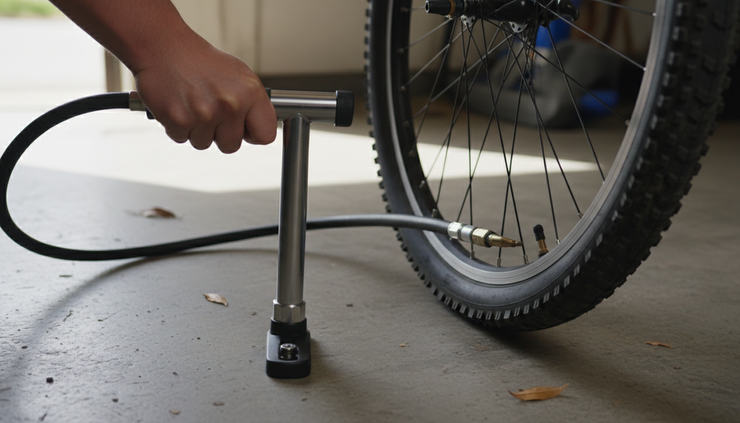
Smaller volume | Particles have less space, so collisions happen more often | Pushing down a bicycle pump |
This gives us the main gas relationships that many science classes introduce as gas laws.
Boyle’s law connects pressure and volume
Boyle’s law says that when temperature stays constant, decreasing the volume of a gas increases its pressure.
Picture pressing the plunger on a syringe with the tip sealed. The same number of gas particles now occupy less space. They hit the syringe walls more often, so the pressure rises.
That is why compressing air takes effort. The harder you squeeze it into a smaller space, the more strongly it pushes back.
Charles’s law connects temperature and volume
Charles’s law says that when pressure stays constant, heating a gas makes it expand.
A balloon offers a simple example. If the air inside warms and the balloon can stretch, the faster-moving particles push outward and the volume increases. If the balloon cools, the particles move more slowly and the balloon shrinks.
This is also part of how hot-air balloons work. Heating the air inside the balloon causes it to expand. Some air leaves through the bottom opening, so the air inside becomes less dense. The balloon rises because the cooler, denser surrounding air provides an upward buoyant force.
Gay-Lussac’s law connects temperature and pressure
Gay-Lussac’s law says that when volume stays constant, heating a gas increases its pressure.
A sealed aerosol can or propane tank should never be heated because the gas inside cannot expand much. As temperature rises, the particles move faster and hit the container walls harder. The pressure increases, which can become dangerous.
This is one reason many pressurized containers carry warnings about high heat.
The ideal gas law ties the relationships together
The gas laws can be combined into one compact equation:
`PV = nRT`
This is called the ideal gas law. Each letter represents a measurable property:
`P` is pressure
`V` is volume
`n` is the amount of gas
`R` is the gas constant
`T` is temperature in kelvin
The ideal gas law works best for gases at relatively low pressure and high temperature, where particles are far apart and do not interact strongly. Under those conditions, many real gases behave close to the ideal model.
The equation is useful because it shows how pressure, volume, amount of gas, and temperature fit together. Change one, and at least one other must change too, unless something else compensates.
For example, if a sealed rigid tank has a fixed volume and a fixed amount of gas, raising the temperature must raise the pressure. If a balloon has flexible walls and the surrounding air pressure stays about the same, raising temperature tends to increase volume instead.
The ideal gas law is not magic. It is a summary of particle motion. Behind every symbol in the equation are molecules flying, colliding, and transferring energy.
Real gases do not always behave ideally
The ideal gas model is a strong starting point, but real gases can break the rules under extreme conditions.
At very high pressures, particles are crowded closer together. Their own volume starts to matter. At very low temperatures, attractive forces between particles become more noticeable. These forces can cause gases to condense into liquids.
Water vapor turning into liquid droplets is a familiar example. The gas particles slow down and interact enough to form liquid water, such as dew on grass or fog in cool air.
So the ideal gas law is a model, not a perfect copy of reality. Good models are still valuable because they explain a wide range of situations clearly and accurately enough for many uses.
Kinetic theory helps explain weather
Weather is full of moving gases. The atmosphere is mostly nitrogen and oxygen, with smaller amounts of water vapor, carbon dioxide, and other gases. Kinetic theory helps explain why air moves, why storms form, and why temperature differences matter.
The sun heats Earth’s surface unevenly. Land, water, forests, cities, and deserts absorb and release heat at different rates. The air above these surfaces warms or cools in response.
Warm air particles move faster, and warm air often becomes less dense as it expands. Cooler air is usually denser. These density differences help create rising and sinking air, which drives many weather patterns.
Wind starts with pressure differences
Wind forms when air moves from areas of higher pressure toward areas of lower pressure. Kinetic theory explains pressure as particle collisions, so pressure differences reflect differences in air density, temperature, and motion.
Near the ground, a warm region can cause air to rise. As air rises, the pressure near the surface may drop. Cooler surrounding air then moves in to replace it. That moving air is wind.
This process can happen on many scales:
A sea breeze forms when land heats faster than nearby water during the day.
Thunderstorms grow when warm, moist air rises and cools.
Large weather systems develop as pressure differences spread across regions.
Water vapor adds another layer. When moist air rises and cools, water vapor can condense into tiny droplets. That releases energy into the surrounding air, which can help storms grow stronger.
Why air pressure changes with altitude
Air pressure decreases as altitude increases. At higher elevations, there is less air above you pressing down. The gas particles are also more spread out, so collisions happen less often.
This is why a snack bag packed near sea level can puff up when carried into the mountains. The pressure inside the bag becomes greater than the lower outside air pressure, so the bag expands.
Weather balloons show the same idea on a larger scale. As a balloon rises, outside pressure drops. The gas inside expands, and the balloon grows until it may stretch beyond its limit.

Engineers use gas behavior to solve practical problems
Engineering often means controlling energy, motion, and materials. Gases are central to all three.
The kinetic theory of gases gives engineers a way to predict how gases will behave in machines, buildings, vehicles, and tools. It helps them design systems that are safe, efficient, and reliable.
Engines and turbines depend on hot, expanding gases
In a car engine, fuel burns and heats gas inside cylinders. The hot gas expands quickly and pushes pistons. That motion helps turn the crankshaft and move the vehicle.
Jet engines and gas turbines also rely on heated gases. Air enters the engine, gets compressed, mixes with fuel, and heats rapidly during combustion. The fast-moving gases then expand and flow through turbine blades or out the exhaust, producing thrust or mechanical work.
Particle motion explains the chain of events. Heating the gas increases molecular speed. Faster particles create greater pressure or expansion. That pressure or expansion can do work.
HVAC systems move heat with gas laws
Heating, ventilation, and air conditioning systems use gas behavior every day. Air conditioners and refrigerators rely on refrigerants that change pressure, temperature, and phase as they move through the system.
When a refrigerant expands, its pressure drops and it cools. When it is compressed, its pressure and temperature rise. These changes allow the system to absorb heat from one place and release it somewhere else.
The same basic ideas show up in heat pumps, which can warm a home in winter and cool it in summer by moving heat rather than simply creating it.
Safety systems require pressure knowledge
Engineers must account for pressure in tanks, pipelines, aircraft cabins, scuba equipment, and even sports balls.
A compressed gas cylinder stores many particles in a relatively small volume. If it heats up, pressure can rise. Designers include safety margins and pressure relief devices to reduce the risk of failure.
Aircraft cabins also depend on gas behavior. At cruising altitude, outside air pressure is too low for normal comfort and safety. Cabin pressurization keeps the air inside closer to conditions people can tolerate.
These systems may feel far removed from classroom gas laws, but they come from the same foundation: moving particles, collisions, pressure, temperature, and volume.
The small-particle view makes the world easier to understand
Kinetic theory turns gases from an invisible mystery into a clear picture. Gas particles move constantly. Temperature reflects their average kinetic energy. Pressure comes from their collisions. Volume, pressure, temperature, and amount of gas are linked because all four describe the same particle-level behavior from different angles.
That picture explains why tires feel softer in winter, why balloons expand as pressure drops, why storms form from rising warm air, and why engines can turn heat into motion.
The next time air hisses from a pump, fog forms over a field, or a weather map shows high and low pressure, there is a hidden particle story behind it. Tiny molecules are moving, colliding, spreading out, and pushing back, and their collective motion shapes much of the world we experience.
"kinetic"


Comments